
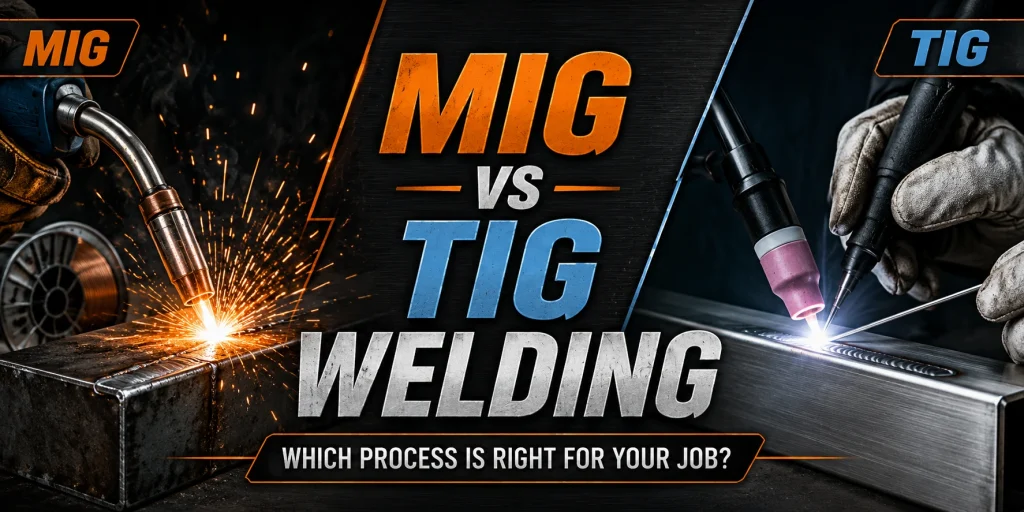
MIG is the practical workhorse for a lot of general fabrication: quick to learn, quick to lay down wire and well suited to repeat work. TIG slows the job down but gives the welder finer control over the arc and filler. That control matters when the joint is delicate or the finished weld will stay on show.
A tidy TIG bead does not make TIG the right answer to every job. Start with the metal, joint and outcome. Then choose the process.
Bottom line: Choose MIG when productivity, general fabrication and an easier learning curve matter most. Choose TIG when fine heat control, precision and a clean visible finish justify the slower process and higher skill requirement.
MIG vs TIG at a glance
| Decision factor | MIG/MAG | TIG |
|---|---|---|
| Electrode | Continuously fed consumable wire | Non-consumable tungsten electrode |
| Filler metal | Wire is normally the filler | Separate filler rod where required |
| Operator input | Torch movement; machine feeds wire | Torch control plus manual filler and sometimes remote current control |
| Typical strength | Process can produce sound structural welds under a suitable procedure | Process can produce sound structural welds under a suitable procedure |
| Speed | Generally higher deposition and faster production | Generally slower |
| Learning curve | Usually easier to begin | Requires more coordination and arc control |
| Finish | Clean results are possible; some spatter may occur | Often chosen for precise, neat visible work |
| Shielding gas | Depends on material and procedure | Commonly argon; exact choice depends on material and procedure |
| Best fit | General fabrication and production | Precision, finish and controlled heat input |
The badge on the machine does not make the weld sound. Preparation, procedure and the person holding the torch do.
How MIG welding works
MIG—metal inert gas welding—is part of the gas metal arc welding family. In steel fabrication, the process may technically be MAG when the shielding gas contains an active component such as carbon dioxide.
The machine feeds wire through the torch. An arc forms between the wire and the workpiece, melting the wire and the joint. Gas flowing through the nozzle protects the weld pool.
Because the filler wire feeds continuously, MIG can achieve high deposition rates and long, efficient weld runs. That makes it a practical choice for fabrication shops, repairs and production where speed matters.
How TIG welding works
TIG—tungsten inert gas welding—uses a non-consumable tungsten electrode to create the arc. Where filler is needed, the welder feeds a separate rod into the pool.
The operator controls the torch, arc length, travel and filler addition independently. Some setups also provide remote current control. That extra control is valuable, but it demands more coordination and practice.
TIG is commonly selected where finish, precision or heat control matters more than deposition speed.
TWI’s MIG-versus-TIG comparison describes the core difference clearly: MIG feeds a consumable wire electrode, while TIG uses a non-consumable tungsten electrode and separate filler where required.
Which process is easier to learn?
MIG is usually easier for a beginner to start because the machine feeds the filler wire. The operator can focus on torch angle, travel speed and maintaining the correct distance from the work.
TIG asks more of both hands. The welder holds a steady arc with one hand while adding filler with the other. Material preparation and tungsten condition also have a visible effect on the result.
“Easier to start” does not mean “automatic”. A MIG machine with the wrong voltage, wire-feed speed, polarity, gas or drive-roll setup will still produce a poor weld.
Which process is faster?
MIG normally wins on deposition and production speed. The continuously fed wire allows longer welds without stopping to add a filler rod.
TIG is slower because the operator controls filler addition and usually spends more time on preparation and fit-up. That slower pace is worthwhile where control and finish justify it.
Arc time is only part of the workshop clock. Preparation, cleanup and rework count too—as does the finish the customer is paying for.
Which process produces the better-looking weld?
TIG is often chosen for neat, visible welds because the welder has close control over the pool and filler. MIG can also produce a clean, consistent bead when the joint, settings, gas and technique are correct.
Appearance alone does not prove weld quality. A smooth bead can still have lack of fusion, contamination or another defect. Where the weld is consequential, follow the approved procedure and inspection requirements.
What materials can MIG and TIG weld?
Both processes can weld a range of metals when the power source, current type, gas and consumables are correct.
Mild steel
MIG/MAG is widely used for mild-steel fabrication because it is productive and accessible. TIG may be selected for thin, detailed or visible work.
Stainless steel
Both processes can weld suitable stainless steels. Wire or filler selection, shielding gas and contamination control matter. Avoid using tools contaminated with carbon steel on prepared stainless surfaces.
Aluminium
Both MIG and TIG can weld suitable aluminium alloys, but the equipment requirements differ.
MIG aluminium needs a reliable way to feed soft wire, often using a spool gun or push-pull system. It also requires compatible wire, shielding gas and machine settings. TIG aluminium commonly requires an AC-capable TIG power source for the work typically encountered, plus suitable tungsten, filler and gas.
Do not assume a machine can weld aluminium because the front panel says MIG or TIG. Check the documented capability and accessories.
What equipment does each process need?
A MIG setup may require
- a compatible MIG/MAG power source and wire feeder;
- the correct MIG torch and contact tip;
- solid or flux-cored wire suited to the job;
- the correct drive roll and liner;
- shielding gas, regulator/flowmeter and hose for gas-shielded work;
- the correct polarity;
- suitable PPE and fume control.
A TIG setup may require
- a suitable TIG power source with the required current type and start method;
- a compatible TIG torch;
- tungsten electrode and torch consumables;
- filler rod where required;
- shielding gas, regulator/flowmeter and hose;
- remote current control where the equipment and work call for it;
- suitable PPE and fume control.
A multi-process power source does not guarantee that every torch, regulator, pedal or consumable is included.
When should you choose MIG?
MIG is a strong starting point when you need:
- productive general fabrication;
- longer weld runs;
- an easier process for a new operator to begin learning;
- routine mild-steel work;
- a process that fits repeated workshop jobs.
When should you choose TIG?
TIG is worth considering when you need:
- fine control over heat and filler addition;
- neat visible welds;
- detailed work on suitable thin material;
- precise stainless-steel or aluminium work;
- the control to respond closely to fit-up and joint conditions.
What about a multi-process welder?
A multi-process machine can reduce the number of power sources you need, but it does not remove the differences between the processes.
Check:
- which processes are genuinely supported;
- whether TIG is scratch, lift or high-frequency start;
- whether the TIG output is DC only or AC/DC;
- what torches and gas equipment are included;
- whether a spool gun is supported for aluminium MIG;
- the duty cycle under the conditions you intend to use.
The Pinnacle MIGARC 195, DABU 225 Pulse MIG Welder and PRIMIMIG 251C illustrate why the exact specification and package list matter. Their supported processes and included equipment are not identical.
A simple way to choose
Ask these questions in order:
- What metal and thickness are you welding?
- Is speed or fine control more important?
- Must the weld remain visible?
- Will you weld indoors, outdoors or both?
- What power, gas and air services are available?
- What experience does the operator have?
- Does the quoted package include the required torch and accessories?
If the answers point in different directions, bring the job details to someone who understands both the machine and the work.
Frequently asked questions
Is TIG stronger than MIG?
Not by default. Both processes can produce sound welds. Strength depends on material, joint design, preparation, filler, parameters, technique and procedure compliance.
Is MIG better for beginners?
MIG is usually easier to begin because the machine feeds the wire. Beginners still need to learn preparation, settings, torch control and safe practice.
Can one machine do MIG and TIG?
Some multi-process machines can. Confirm the TIG start method, current type and required accessories. TIG equipment may be sold separately.
Is TIG always cleaner than MIG?
TIG is commonly selected for controlled, neat visible welds. MIG can also produce clean results. The required finish and production rate should guide the choice.
Which process should I use for aluminium?
That depends on material thickness, finish, production requirement and equipment. MIG needs a suitable aluminium wire-feed arrangement; TIG commonly needs an appropriate AC-capable power source for aluminium work.
Choose the process before the machine
Send us the metal, thickness, job location and finish you need. We will compare the sensible MIG, TIG and multi-process options, then spell out which torches and accessories are extra. The goal is the right kit for the job, not the bigger sale.
